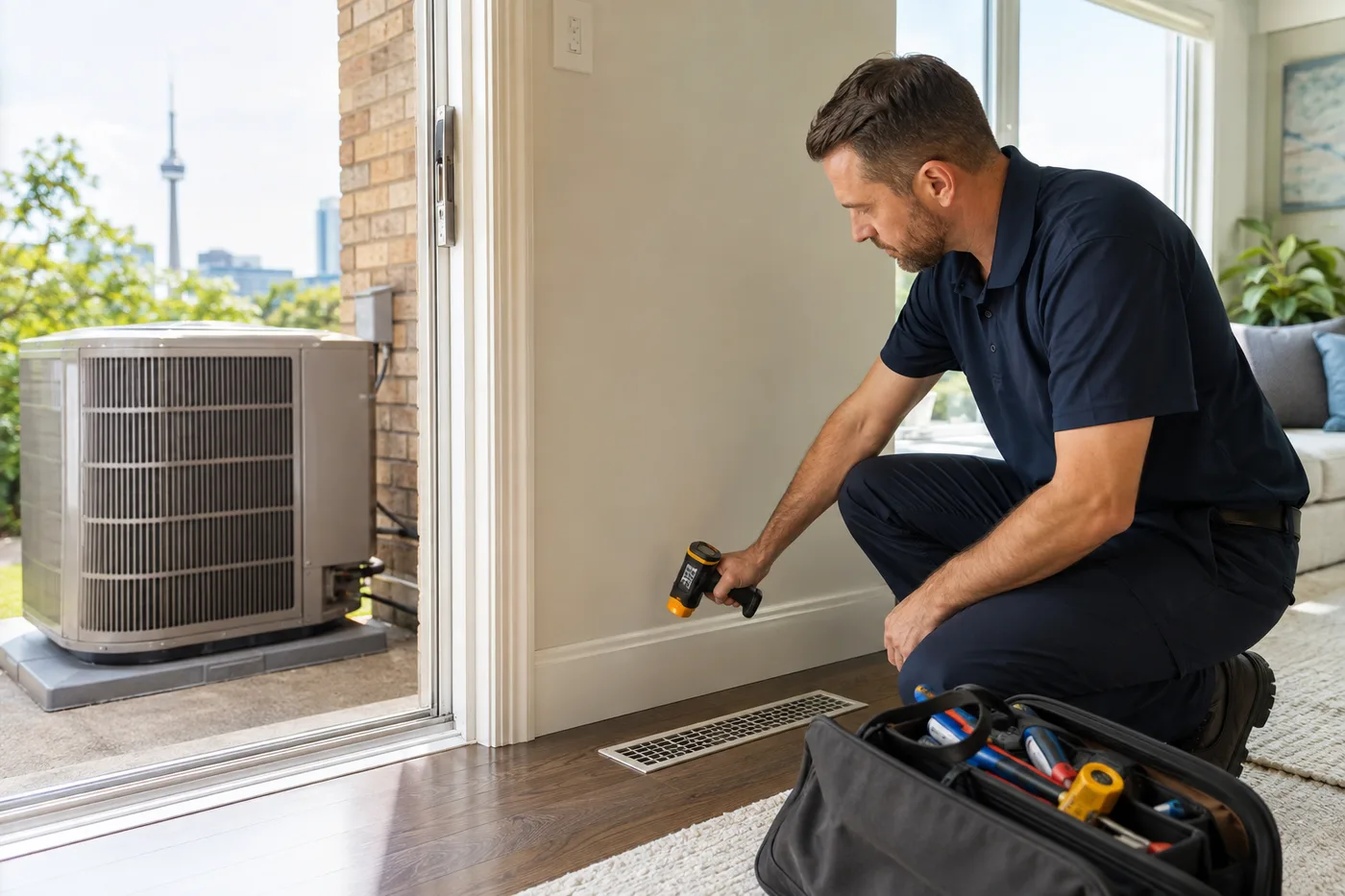
“The AC is running” may mean the thermostat is on, the indoor blower moves air, the outdoor fan spins or the complete refrigeration circuit operates. Those are not equivalent. A useful diagnosis establishes what is actually running, whether heat is removed, whether air reaches the occupied rooms and whether the building load or distribution prevents the result.
Safety and scope: This guide supports a service decision. It does not replace model instructions, official emergency guidance or a qualified on-site diagnosis.
Define the decision before choosing the work
Moving air or an operating sound does not prove that the refrigeration cycle, airflow, controls, drainage and duct delivery are working together. The useful starting point is the condition that can be observed on the installed system, not the part or product most often mentioned online. Two Toronto properties can report the same symptom and need different work because equipment type, fuel or energy source, controls, air distribution, envelope, access and service history are different.
Build a short timeline: when the condition started, whether it is constant or intermittent, which rooms are affected, what the thermostat showed, what the outdoor weather was doing and what changed beforehand. A power interruption, filter change, renovation, new schedule, tenant turnover or earlier repair can redirect the investigation. This history guides testing, but it does not turn a phone conversation into a diagnosis.
- whole-home or room-specific heat
- indoor and outdoor equipment behaviour
- supply-air change
- runtime and weather
- recent filter, power or renovation changes
Safe observations before requesting Toronto HVAC service
Check cooling mode, setpoint and an accessible filter, but stop if ice, water near electrical parts, repeated breaker trips, smoke or severe mechanical noise appears. A property contact can usually record thermostat mode and setpoint, note whether the indoor and outdoor equipment respond, photograph an accessible model label and check an accessible filter without removing panels. Record visible water, ice, error messages, unusual sound and odour from a safe position.
Stop and seek the appropriate emergency guidance for smoke, suspected gas, carbon-monoxide alarms, sparking, repeated breaker trips, severe mechanical noise or water reaching electrical equipment. Do not bypass a safety, repeatedly reset power, open fuel or refrigerant compartments, climb onto a roof or enter an unsafe attic. The website request form is not an emergency service and must never delay life-safety action.
- Record the symptom before changing settings
- Keep model and error-code photos clear
- Protect people and property first
- Do not dismantle equipment to collect information
How a qualified diagnostic sequence approaches an air conditioner that runs without cooling
A defensible sequence moves from demand through equipment operation to delivery. Depending on the system and complaint, it may examine thermostat demand, indoor blower delivery, coil and drain condition, outdoor electrical and mechanical sequence, refrigerant-side evidence, and duct delivery and room load. Each reading should answer a specific question. A list of numbers without their operating conditions, expected range or connection to the complaint does not create a useful conclusion.
Diagnosis must also ask whether a reported failure is primary or protective. A limit, pressure control, float switch or fault code may be operating correctly because airflow, drainage, combustion, electrical supply or another condition is outside limits. Replacing the device that reports the problem without identifying what triggered it can create recurrence and remove important protection.
- thermostat demand
- indoor blower delivery
- coil and drain condition
- outdoor electrical and mechanical sequence
- refrigerant-side evidence
- duct delivery and room load
Airflow, distribution and the building behind the equipment
Heating and cooling equipment operates inside an air-distribution system and a building. Relevant evidence may include filter restriction, blower speed, evaporator loading or ice, return limitations, supply leakage, and closed-room pressure. A clean register does not prove adequate airflow, and new equipment cannot correct a disconnected branch, undersized return, closed room path, restrictive filter or poorly insulated duct by itself.
Room load matters. Window exposure, an added office, finished basement, cooking, electronics, occupancy, air leakage and an exterior door used frequently can alter what a room needs. Distribution should be compared with those conditions before capacity is blamed. Closing registers or increasing equipment size without pressure and load context can worsen noise, cycling and comfort.
- filter restriction
- blower speed
- evaporator loading or ice
- return limitations
- supply leakage
- closed-room pressure
Thermostat, staging and control factors
The thermostat is one point in the control chain. The investigation may need to consider fan-only setting, cooling stages, float and equipment safeties, relays or contactors, and smart recovery and schedules. A normal display does not prove that a demand reaches the correct stage or that every safety and sensor agrees. Smart controls can add useful history, but they also introduce configuration, account, network and compatibility questions.
Record the settings that existed when the issue appeared before changing every menu. With staged or variable equipment, long operation at lower output can be normal, while repeated aborted starts or missing stages deserve review. Heat pumps add reversing, defrost and auxiliary-heat logic; condo fan coils add building water and seasonal changeover conditions beyond the suite thermostat.
- fan-only setting
- cooling stages
- float and equipment safeties
- relays or contactors
- smart recovery and schedules
Toronto winter, summer and shoulder-season context
Toronto conditions change the weight of the decision. Relevant factors include humid heat events, hot upper floors, attic equipment, outdoor debris, shoulder-season low load, and condensate risk. A furnace problem during freezing weather and an air conditioner problem during a humid heat event create different risks, test conditions and scheduling pressures. A seasonal system can also be difficult to prove outside the mode or load that produced the complaint.
Climate should inform measurements rather than become sales language. Heat loss, solar gain, air leakage, snow and outdoor-unit clearance, attic or mechanical-room temperature, humidity, condensate and freeze-thaw exposure can all matter. The proposal should connect any weather claim to this property and this installed system instead of assuming every Toronto building behaves the same way.
- humid heat events
- hot upper floors
- attic equipment
- outdoor debris
- shoulder-season low load
- condensate risk
What a clear HVAC repair scope should contain
When the condition is verified, a repair scope may include verified electrical, control, airflow, drain, mechanical or refrigerant fault, related causal correction, safe access and property protection, and cooling verification. It should name the fault, related causal work, parts or materials, access assumptions, exclusions and the checks planned after completion. A component name and total price are not enough to compare if cleaning, wiring, drainage, refrigerant, controls or restoration are treated differently.
Separate immediate restoration from optional improvement. A repair can restore safe operation while duct correction, filtration, insulation or planned replacement remains a second decision. The reverse is also possible: a component repair may be poor value when another documented condition will continue to damage it. The customer should be able to trace each line of work back to a finding.
- verified electrical, control, airflow, drain, mechanical or refrigerant fault
- related causal correction
- safe access and property protection
- cooling verification
When to compare repair with replacement
Replacement is not established by age alone, and repair is not automatically economical because the unit can restart. A balanced comparison considers repeat failure history, compressor and coil condition, refrigerant/parts support, system matching, duct capability, and humidity and comfort history. It also considers ownership plans, comfort history, existing duct or electrical limitations and whether indoor and outdoor components can remain properly matched and supported.
Compare complete outcomes. A replacement scope should address sizing or load method, matched components, controls, distribution, drains, fuel or electrical coordination, permits where applicable, removal, commissioning and written warranty terms. A repair scope should state what is restored, what remains unchanged and what uncertainty cannot be removed before disassembly or operation.
- repeat failure history
- compressor and coil condition
- refrigerant/parts support
- system matching
- duct capability
- humidity and comfort history
Property type, access and authorization in Toronto
The same technical condition becomes a different project across houses, vertical row homes, condos, rentals, offices, and retail spaces. A house may place equipment in a basement or attic. A condo may require management approval, elevator booking or mechanical-room access. A rental adds owner, tenant and manager roles. A multi-unit or commercial property adds shutdown windows, site safety and a defined approval chain.
Provide the exact Toronto postal code, equipment location, parking or loading notes, unit/buzzer details and the person authorized to approve work. These facts help route the visit; they do not guarantee coverage or timing. Where gas, electrical, roofing, plumbing, structure, environmental testing or building automation belongs to another qualified party, the boundary should be stated before work.
- houses
- vertical row homes
- condos
- rentals
- offices
- retail spaces
Cost factors and estimate boundaries
AC repair cost changes with diagnosis, access, electrical or refrigerant work, leak testing, parts, thaw time, condensate damage risk and whether indoor and outdoor components remain compatible. A useful estimate separates the diagnostic visit from approved repair or installation work and explains taxes, deposits, parts ordering, access equipment and conditions that could require a written change. An online price range cannot account for every model, configuration, condition and property constraint.
Compare scopes, not just totals. Two proposals can use similar equipment names but include different controls, duct transitions, electrical work, drainage, protection, disposal, permits, startup and follow-up. If a fixed price is offered, the included condition and exclusions still need to be written. If time-and-material applies, rate, minimum and authorization steps should be clear.
- Diagnostic or assessment charge
- Parts, labour and consumables
- Access and property protection
- Permits, tax and separately approved changes
Questions to ask before authorizing the work
Require the work to explain why the system ran without delivering cooling and what evidence will show correction. Ask what condition was verified, which observations support it, what the work includes, what remains uncertain and how the result will be checked. For equipment replacement, ask how capacity, component matching, controls, airflow and commissioning were handled. For repair, ask what caused the failed component and whether that cause is included.
Business claims require current evidence. Confirm the legal company identity, TSSA fuels-contractor information when fuel work is involved, technician qualifications applicable to the scope, insurance wording, permit responsibility, warranty terms, payment schedule, financing details and cancellation rights. A badge, review snippet or verbal assurance is not a substitute for the document relevant to the actual contractor and job.
- What evidence supports the recommendation?
- What is included and explicitly excluded?
- What could change after authorization?
- How will the finished result be verified?
Prepare for a productive service visit
Record which equipment runs, rooms affected, temperature trend, visible ice or water and the outdoor conditions when cooling declined. Gather model and serial photos if safely accessible, thermostat screenshots, prior invoices, filter details, error history and a concise timeline. Do not clean away water patterns or reset every fault immediately before the visit unless safety or property protection requires shutdown.
Clear safe access to the equipment and affected rooms, secure pets, identify fragile surfaces and tell the provider about tenants, alarms, parking, elevators, ladders or restricted hours. For a condo or managed property, confirm who can authorize suite and common-element access. Preparation reduces avoidable delay without predetermining the diagnosis.
- Thermostat mode and setpoint
- Indoor/outdoor unit behaviour
- Rooms affected
- Filter condition
- Ice, water, sound and error history
Verification and records after the HVAC work
Completion should return to the original complaint. Depending on the scope, verification may include indoor and outdoor sequence, supply/return response, stable electrical operation, airflow, drainage, and room temperature trend under suitable load. The correct readings depend on equipment, operating mode, weather and manufacturer information, so a single universal number should not be promised. The closeout should identify what changed, what was tested and what could not be evaluated.
Keep the approved scope, invoice, model and serial information, startup or commissioning record, filter size, settings, warranty documents, permits or inspection records where applicable and any monitoring instructions. If the symptom returns, dates, weather, settings and fault information make follow-up more productive than beginning again with a general complaint.
- indoor and outdoor sequence
- supply/return response
- stable electrical operation
- airflow
- drainage
- room temperature trend under suitable load
Common mistakes that weaken the decision
Common shortcuts include assuming refrigerant is always low, judging temperature by hand, running a frozen system, replacing a thermostat without checking safeties, and ignoring a disconnected duct. They feel decisive because they name a product or action quickly, but they may leave the causal condition untouched. A sound process preserves uncertainty until testing supports a conclusion and then translates that conclusion into a scope the property owner can understand.
The goal is not the longest checklist. It is a traceable line from symptom to evidence, from evidence to recommendation and from authorized work to verification. That line protects the customer from premature replacement, protects the contractor from unclear expectations and creates a record that helps if the condition changes later.
- assuming refrigerant is always low
- judging temperature by hand
- running a frozen system
- replacing a thermostat without checking safeties
- ignoring a disconnected duct
Service-visit checklist
Information to prepare before requesting Toronto HVAC service
- Thermostat mode and setpoint
- Indoor/outdoor unit behaviour
- Rooms affected
- Filter condition
- Ice, water, sound and error history
Questions about this Toronto HVAC decision
Frequently asked questions
Why does a Toronto AC run all day?
Long cycles can occur near high load, but declining temperature control, rising humidity, reduced airflow, ice or a changed pattern can indicate a condition that needs testing.
Can a Toronto HVAC problem be diagnosed from a photo or phone call?
Photos and a precise history help identify equipment and route the visit, but most repair conclusions require safe access, operating observations and measurements.
Does this guide replace an on-site HVAC inspection?
No. Equipment-specific safety procedures, manufacturer information, current requirements and a qualified field diagnosis control the actual work.
What should a written Toronto HVAC proposal document?
It should identify the equipment and verified condition, included work, access assumptions, exclusions, authorization terms and completion checks. Credentials, warranty, permit, schedule and price terms must be current and written.